SIA’s New Design Guide Might Break Your Photo Capture Process
You’re working a night shift, and a nurse you’ve never seen before is walking down the hall toward you. "Must be a new hire," you think to yourself. She is wearing the standard blue scrubs, moving with confidence, and appears to belong in the Critical Care Unit. As she passes, you catch a glimpse of her ID badge, but the photo is low-resolution and shadowed. You have a hard time registering whether the face on the badge actually matches the person who just walked by.
You feel a little uneasy, but decide to shrug it off and keep moving through your shift. Surely security has vetted this woman – you’re probably just being paranoid.
By the end of your shift, the assumed “new hire” has stolen over 100ml of Propofol and left patients without their medication.

This isn't a hypothetical scenario. In 2025, Marissa Jean Denton used this exact “visual blending" technique to infiltrate Vanderbilt University Medical Center and St. Thomas Midtown Hospital. By the time staff realized she wasn't an employee, she had already gained access to the ICU. She was caught drawing the Propofol,a potent anesthetic, directly from a patient’s active IV drip.
This real-world incident underscores the reality that identity-based threats are consistently among the most common security failures across industries, and most of them depend on one thing: the ability to pass as someone you’re not. When a badge photo can’t be quickly verified, the ability to exploit it becomes much easier.
ID badges are the first line of identity verification. The photo on a badge should confirm its wearer in a split-second glance. Bad photos open the door to identity impersonation, fraud, and major security risks.
The Security Industry Association (SIA) just released its new Corporate Credential Design Guide, which outlines specific standards for compliant ID photos and explains why adherence to these standards matters.
What the SIA's New Corporate Credential Design Guide Actually Recommends
The SIA guide (available here) establishes photo standards across six key dimensions:
Resolution - photos should be at least 5 megapixels (MP). High resolution prevents distortion, supports facial recognition, and enables future identity verification options like CCTV matching and biometric integration
Lighting - lighting should be soft and evenly distributed. Shadows, glare, and colored lighting make skin tone harder to read and impede both human and automated verification.
Positioning & Expression - the subject should be centered, upright, and facing forward, with a neutral expression and eyes open and clearly visible.
Background - background should be uniform and neutral in color (white, gray, or corporate-standard blue). Patterned backgrounds reduce contrast and make verification harder.
Framing & Cropping - head and shoulders should be clearly visible, with the face occupying 50-69% of the image height and the eye line positioned at 55-65% from the bottom.
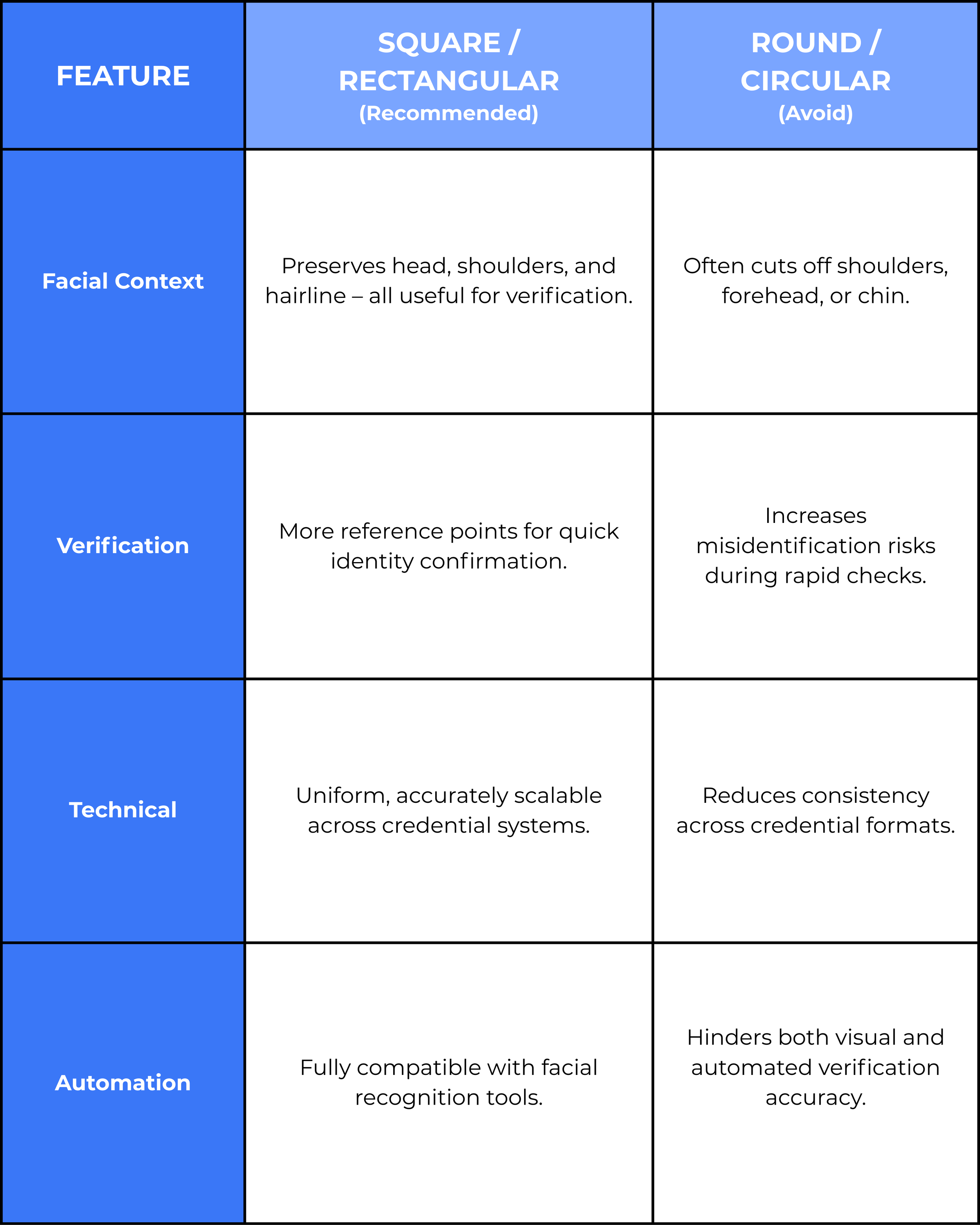
Design: Square/Rectangle vs. Circle (see table) - one of the more technical but consequential points in the guide concerns frame geometry. Circular crops, common in consumer apps and modern digital design, are explicitly flagged as a problem for credential use.
Why These Standards Could Break Your Photo Capture Workflow
The SIA guide calls for standardized camera kits, fixed shooting distances, operator training, and quality checks at the point of capture. In a single-location organization with a dedicated HR team, that's achievable. For distributed teams, high-volume onboarding, or organizations relying on emailed selfies and inconsistent setups, it breaks down quickly.
It may be easier to blame the standards for the bottleneck, but it's actually the capture and enforcement process at fault. Manual workflows produce inconsistent outcomes even when the intent is there. One site follows the protocol correctly; another site's coordinator substitutes their phone camera. The result is a credential program that looks compliant on paper but isn't in practice.
Adherence to these standards also has a formal dimension worth noting: the SIA guide aligns with ISO/IEC 19794-5 and ICAO 9303, which are the same international biometric benchmarks used in passports and government-issued IDs. Organizations that meet this bar are building credentials that are interoperable across systems and sites, and that hold up under formal scrutiny.
How AI-Powered Capture Addresses the Scale Problem
One solution gaining traction is remote, AI-guided photo capture (something we know a lot about)! This type of software walks employees through the capture process on their own devices, validates compliance in real time, and automatically flags issues such as poor lighting, off-center framing, or facial obstructions before the photo is submitted.
The value isn't in removing humans from the process entirely, but instead, in removing the variability. A guided capture workflow applies the same standards whether an employee is onboarding in your headquarters or at a remote field location. Built-in quality checks reduce reprints, callbacks, and the downstream costs of non-compliant credentials.
This approach is worth considering seriously if your organization struggles with any of the following:
High employee volume or rapid onboarding cycles
A major rebadge on the horizon
Distributed locations without on-site photo stations
Reliance on emailed selfies
Inconsistent badge quality across facilities or departments
Looking Ahead: Biometrics and Future-Proofing
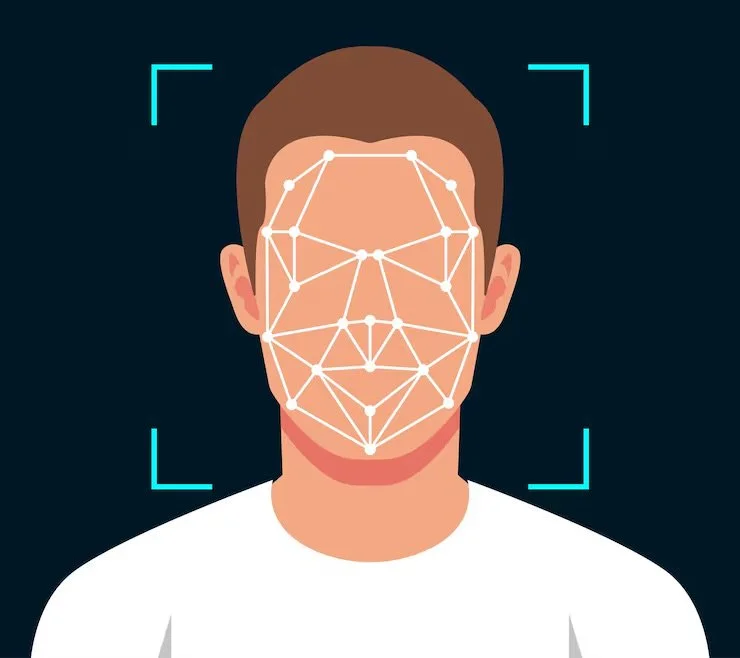
The SIA guide notes that standardized photos are the foundation for facial recognition, CCTV matching, and mobile credential verification. The future is on our doorstep. Enterprise biometric programs are already in deployment across healthcare, financial services, and critical infrastructure.
Organizations that invest in photo quality now are building a credential asset that will continue to deliver value as verification technology advances. Retrofitting a biometric program on top of a credential library full of low-quality images is expensive and slow. Getting the photos right the first time is the simpler path.
Auditing Your Current Workflow
If the SIA standards raise questions about your organization's compliance, an honest audit of your current process is a good starting point. Some questions worth asking:
Does your current workflow consistently produce photos that meet resolution, lighting, and framing standards?
Are quality checks built into the capture process, or do problems only surface after badges are printed?
Are your standards applied consistently across all locations and onboarding scenarios?
Have there been any incidents or near-misses that suggest identity verification isn't working as designed?
The right next step depends on what you find. If your current photos fall short of the SIA standard, it may be time to evaluate whether your capture process can realistically get you there and what it would take to fix it.
The nurse with the bad badge photo is a cautionary tale. It's also a preventable one.